August 8, 2017


I started The Daily Bird New England over three years ago with the goal to acquaint beginner bird watchers to the fluxing, familiar and rhythmic changes of bird life in New England.

I set out to create a post for each day of the year and while I have not yet reached this goal I am moving onto the next chapter of this project (more to come on that soon). I am leaving the site in what I hope is an accessible archive of the existing posts organized by month (see images to the right) and that can be revisited periodically.

For the new comer to bird watching the diversity and fleeting nature of the prize can be daunting. While a field trip with an expert is a great learning opportunity it can also prove disheartening. “How could that tiny brown flash have been a Song sparrow?” The missing piece here is the fact that the long time bird watcher is often not cognizant of, or at least not verbalizing the mental process she goes through to identify the “brown flash.”

An experienced birder will almost never start the process of identifying a bird with the statement, “The date today is January 7th. I’m located three miles north of latitude 42 degrees, facing into a cold wind on a barrier beach by the Atlantic Ocean.” These all-important details are so ingrained in the very experience of bird watching in early January at Plum Island, Massachusetts that they go unspoken. However, the time of year, weather, location, and habitat are often more valuable to identification than the color of the outer wing feathers of the bird in question. The setting and context in which a bird is seen is a huge factor in correct identification and this is the context I hoped to express in the Daily Bird New England.  

I'll go further in that place and time are more than a leg up on identification but the very reason for bird watching in the first place. What makes bird watching so entrancing is the growing awareness of the layers of life painted onto a specific place. Layers that include the rocks and soil, the vegetation, the weather, topography, and all the slithering, hiding, climbing and flying biota that animate that place.

I hope that you will continue to enjoy checking in with the Daily Bird New England, and stay tuned for the next chapter. As always feel free to contact me with questions or comments, or if you’d are looking for a speaker or educational program.

Happy bird watching,


Alex 

July 26, 2017

Chasing Totality: an Eclipse Adventure

Hello old friends and readers of the Daily Bird New England. I have been on long hiatus from the Daily Bird project as I refocus my energy on a book. The book deals with many of the same topics of bird watching, nature, education, culture and science that I first started writing about on this site. While the book is still in draft infancy (I will get word out when that changes) I am currently engaged in a small side project that I thought you might be interested in.

The project is called, Chasing Totality: an Eclipse Adventure. As of July, 2017 I find myself living some 300 miles north of the "path of totality" of the Great American Eclipse that will occur on August 21, 2017 across the Unites States. I've decided to set out to see this event in person and plan to record my experiences as well as interview people along the way, and attempt to explain some of the history, science and meaning behind this rare event.

As fellow nature lovers I thought you may be interested in following my adventures as they unfold from my new website: www.AlexanderDunn.org. 

Happy bird watching and all my best,

Alexander

January 2, 2015

Join me for "Winter Birding at Plum Island" Sunday, Jan. 11

Winter Birding at Plum Island
Sponsored by Broad Meadow Brook Wildlife Sanctuary
Sun, Jan 11, 2015 10:00 am - 7:00 pm
Location: Worcester to Plum Island
Instructors: Alex Dunn - Birder and Natural History Guide; Martha Gach - Conservation Coordinator

Search for winter ducks and raptors along the coast.  We'll head for Salisbury Beach, then Joppa Flats for lunch, and Parker River National Refuge until dusk in hopes of seeing short-eared owls. The van leaves Broad Meadow Brook Visitor Center at 10 am, returning by 7. Snowy owls, northern harriers, and northern pintail are among recent sightings at the refuge.

Instructions and Directions: Bring a lunch, drink, and heavy snacks. Dress warmly in layers for moderate walking. Binoculars and your favorite field guide are recommended; we will have loaners and a scope.

Members: $35.00
Non-Members $42.00
Nonmembers can join today during checkout and take immediate advantage of member prices.

Registration is required.
Register online or call 508-753-6087 to register by phone.
For your own security, DO NOT send credit card information via email.
For more information, contact:

Broad Meadow Brook Wildlife Sanctuary
414 Massasoit Road
Worcester, MA 01604-3546
bmbrook@massaudubon.org

November 20, 2014

Eastern Bluebird - winter's blue

The Eastern Bluebird is more an icon than a native New England bird. Immortalized on sweatshirts and as porcelain figurines as well popularized by a widely followed conservation movement the Eastern Bluebird remains a fan favorite. Known as a partial migrant the bluebird sometimes stay on their breeding grounds in unseasonably warm winters or during bumper fruit crop years and can be found in New England all year long. As omnivores, bluebirds subsidize their summer diet of insects and grubs with winter berries and fruits. A picture of tranquility however, bluebirds are not. Territorial wars with other cavity nesters like  English house sparrows and European Starlings can turn deadly.  A bird of open ground such as meadow or pasture, the decline of the bluebird was in part due to these invasive birds competing for limited cavity nest sites in a sprawling suburban world. The extensive loss of farmlands in the Northeast since the 1970s was also to blame. But, the outlook for the bluebird is good. Christmas Bird Counts show a near 14% increase in bluebird sightings between 1964 and 2008 while the 2011 Massachusetts Breeding Bird Atlas give bluebirds a “likely increase” status. It seems that substantive nest box building projects cut down on competition and have allowed these midsized song birds to flourish. In the winter watch for bluebirds flying from ground to fence post in barren farm fields or orchard edge. For all their marvelous color bluebirds can be inconspicuous, appearing grayish in the long winter light. Watch for a characteristic flight style, with long wings that seem to lap the air like a dog’s tongue, pushing downward and barely rising above the back.

October 11, 2014

The ubiquitous Blue jay, stealer of chips, chaser of cats, lone Canadian major league baseball team


Most bird watchers learn to identify the Blue jay as a child, the stuff of early readers “blue is for Blue jay” and the smiling, more recently frowning mascot for the Toronto baseball team, Blue jays are one of those birds “that everyone knows.” However, jays are more complicated than we may give them credit for. Members of the corvid or crow family, jays are intelligent socialites that stash acorns stores for winter and even migrate. If a jay seems to be extra jowly, gobbled with thick neck, they may be transporting “mast” the harvest of seeds and nuts produced in the forest. Acorns are a favorite and jays will carefully stash these precious swallows of fat and oils in trees, shallow holes, or under rocks to fortify them during the winter.  Beginning around the Jewish New Year Blue jays can be seen passing over roads in low flights above the tree tops. The jay’s flight style is an open winged glide, on surprisingly long “fingers” or primary flight feathers. An overall roundish wing, with blockish head, they often appear white and grey, the illusive blue of their back and head, washed out by the sky’s light. 

April 10, 2014

Tree swallows – spring arrives on a flash of blue wing

photo by Anne Greene
The tree swallow is a dart of a bird that winters as far south as Central America, Florida, and Baja and returns to New England meadows and marshes in April on a path of weaving bobs and streaming wires of iridescence. On the wing and in bad light Tree swallows can appear black on the back with a white belly, but when perched on a nesting box or dead branch the true colors of the swallow become clear, a rich, glossy violet. Swallows are aerial hunters of the finest form. They “hawk” insects on the wing and from afar appear engaged in a lunatic’s spiral. In spring swallows migrate in loose bands but come fall amass in huge flocks by the thousands. Tree swallows are cavity nesters and can be found in meadows where bluebird boxes are present or in the dead trees above a beaver pond. Watch for these aerial masters as they have returned to New England.

April 9, 2014

Protect the spring warblers one sip at a time

More Trees = More Coffee
A recent article on American Association For The Advancement Of Science's website outlined the important role insectivores like warblers can play keeping coffee plantations healthy. 

Would you like a tree with your coffee? That may not sound like a good idea, but a new study suggests that mixing trees with coffee bushes could boost bird populations while improving crop yields. Among the chief threats bean growers face is the coffee berry borer (Hypothenemus hampei), an insect that lays its eggs after digging into coffee berries. Recent studies in Jamaica’s “high mountain” coffee farms suggest that introducing insect-eating warblers... continue reading 

The Daily Bird has addressed the issue of "bird friendly coffee" before and as more and more information unfolds it is ever more clear that preserving species means preserving land along all places in these tiny birds lives. From the mountain jungles of Costa Rica and Jamaica to the Texas coast, Mississippi valley, coastal marshes of the Northeast Unites States and Canadian boreal forests this is truly a massive, multinational conservation effort. 

One small step we can make is avoiding "sun coffee." This fast growing coffee viraital grows happily in large mono crop fields. It is cheap and easy and guess what it's the stuff we pour down our throats from all the Dunkin Donuts, 7-Elevens, and cheap store bought grounds. Make a change and buy only shade grown coffee and help protect important tropical habitat for "our" warblers. 

March 24, 2014

Timberdoodle, Bogsucker, Labrador Twister or funnier still… the American Woodcock

Beginning in late February and going straight through the summer one of the most curious evening sounds by the most curious of New England birds occurs. The American woodcock is a grapefruit shaped shorebird (think sandpiper) that lives far from open water or sandy dunes. Compact, long billed, and wide-eyed these ground nesting shorebirds put on one of the early spring’s great aerial displays with accompanying outer space soundtrack.

The male woodcock finds a favorite piece of open field, often close to mature forest and moist with puddles of spring thaw. Known as a “singing ground” the male bird gives a series of “peeeent” calls before rocketing 100 yards into the air and flying a huge circle above the trees and open field. This flight is made even more bizarre by one of the great non-vocal sounds of the avian world. Spaces in the leading, primary wing feathers create a shimmery, twittering sound like a Hollywood robot processing a request from astronaut Mike Jones’ to "change trajectory".

This whole scene is made even more unearthly by the woodcock’s preference for crepuscular display in that enchanted gloaming light in the hour before dark. This flight serves to attract a willing female for mating. Being polygamous the males will often continue to perform this display flight each evening throughout the spring and summer. To find a Woodcock take a walk or park near an open meadow roughly thirty minutes before dusk and listen for the “peeeent” call and head towards the sound.


ideal setting for Spring Woodock sightings

March 21, 2014

The Birdist on State Birds: What They Should be...

Many people are familiar with the State Bird Program (along with trees, flowers, food, and songs) that has passed into some type of state legislative gavel drop a single specie of bird that they (the gavel droppers) deem representative. The problem is the States bird list reads like a list generated by an angst ridden 8th grader; on one hand fearful of showing real interest on the other totally unaware of local flora and fauna (3 Robins, 5 Mockingbirds, 7 Cardinals)! I've written about the Cardinals before. 

I recently came across an amusing post by Nicholas Lund on his site Birdist titled, State Birds: What They SHOULD Be and it is one of the funnier things (bird related) I've read in some time. Despite some Maine - Massachusetts guff over the chickadee I think he gets it pretty right... warning bad language and seriously deep bird references ahead. 

March 14, 2014

and more Snowy owls

A wonderful blog post on the American Birding Association (ABA) blog recounting some of the weirder places Snowy owls have shown up this year. 

If you're not familiar with the ABA they are member driven organization that promotes the ethical and educational pursuit of viewing birds. If you're interested in becoming a member click here. 

March 11, 2014

More Snowy Owls...the Snow Storm Project

Snowy owls made news again today with this incredible (data made public) website called Project Snow Storm. It was featured this morning on National Public Radio as well as being exhibited at the 2014 Annual Birders Meeting (last Saturday, March 8th). 

The project plots real GIS data from radio tagged snowy owls and overlays their movement on Google Maps. If instant world messaging via email, video chatting over Skype, online books and videos haven't made the internet incredible to you then watching real life data of animal movement may be the thing to sell you on this whole Website thing. 


March 6, 2014

Notes from MEES Conference 2014 - the Stories Birds Tell: From Bird Language to Migration


The Stories Birds Tell: From Bird Language to Migration
Alex Dunn, Education/Development, EcoTarium


Birds are an accessible and familiar entryway to the natural world. This session will demonstrate how classroom teachers and educators can unlock the stories birds tell through literacy, technology and field observations. We will explore both schoolyard bird language and international conservation efforts offering curriculum ideas, print and digital resources.


INTRODUCTION

99% Invisible Podcast
Episode 40: Billy Possum
November 23, 2011

Monster of God: The Man-Eating Predator in the Jungles of History and the Mind
by David Quammen

The Big Year: A Tale of Man, Nature, and Fowl Obsession Paperback
by Mark Obmascik

Boston Globe: Cambridge man sets bird-watching record
By Bryan Marquard
January 02, 2014

The Crossley ID Guide
by Richard Crossley

The Development of the Classic Wildlife Diorama
by Gary Hoyle
Journal of Natural Science Illustration


Beyond Ecophobia
by David Sobel
from YES Magazine
November 2, 1998


BIRD LANGUAGE

Bird Language
What the Robin Knows: How Birds Reveal the Secrets of the Natural World
by Jon Young

Cornell Laboratory of Ornithology 


MIGRATION

Ebird

Boreal Songbird Initiative

Migratory Bird Center
Smithsonian National Zoological Park

Audubon Magazine


PHENOLOGY

National Phenology Network

North American Bird Phenology Program - USGS


CITIZEN SCIENCE

Monarch Watch
a nonprofit educational outreach program based at the University of Kansas

Project Budburst
Monitor the first flowering of plants

Project Feederwatch – report bird sightings at feeders throughout the winter and spring

FrogWatch USA
American Zoo Association
Listen for the calls of frogs and toads during their breeding season


Firefly Watch
Museum of Science, Boston


AUDIO

Bird News
with hosts Mindy Todd and Vernon Laux.
The first Saturday of each month from 10am to 11am.

Digital Sound Resources

Inquiry
WICN Radio


CONSERVATION


Silence of the Songbirds
by Bridget Stutchbury


Living Bird News story on bird-friendly coffee habitat http://www.allaboutbirds.org/Page.aspx?pid=2595


Mass Audubon


GENERAL


Environment for the Americas and International Migratory Bird Day


School yard bird watch, citizen science, mini-grants


February 25, 2014

Signs of Spring – Chickadee spring call

photo by Anne Greene
The gregarious champion of Massachusetts birds, the Black-capped chickadee is not only the state bird, a feeder favorite, and friendly charmer but its gentle song is a kind reminder that spring is near. The Black-capped chickadee is a “name sayer” or bird named after its own call or song. Like the Whip-poor-will, Bobwhite, and Crow the chickadee also tells the birder who it is through song. Most commonly heard saying “chick-a-dee-dee-dee” it often shortens this to a quick “chick-a-dee”.

But, as the roof begins to drip and some deep push of sprout begins to break the ground the chickadee turns to a melodious two noted “sweet-ie” or “see-saw” song. This welcoming two note song is heard beginning on sunny February days. The song is bright and breaks through the needles. Listen for the “sweet-ie” call, turn to face the sun, and close your eyes. Spring is near.  

February 20, 2014

Join me Sunday Feb. 23 for a trip to Rhode Island

Winter Ducks at Sachuest Point

Sponsored by Broad Meadow Brook Wildlife Sanctuary
Sun, Feb 23, 2014 9:00 am - 5:00 pm

Location:

Sachuest Point NWR

Instructors:

Alex Dunn - Birder and Natural History Guide; Dan Berard - Birder

Audience:

Adult

Members:

Adult $35.00

Nonmembers:

Adult $42.00
Join us as we once again make a trip to the fantastic coast of Rhode Island to explore Sachuest Point National Wildlife Refuge for harlequin ducks, eiders, surf scoters, and scaup bobbing in choppy, cold waters. Turn your lenses to shore and spy on purple sandpipers crawling over the exposed rocks. Be prepared for bitterly cold winds but hey, it really is fun!

Instructions and Directions:

Bring lunch, binoculars, and a field guide. Dress in layers for the cold weather.
Registration is required.
Register online or call 508-753-6087 to register by phone.
Register by mail: program registration form (PDF 66K)

December 18, 2013

Suet

Winter is the time to feed the birds. Dependent on reliable food sources like cherry trees, winter berries, and open fields - feeders also provide winter birds with an important food store. Suet in particular can make for good fodder. Most often purchased as a store bought “cake” it is possible to get fresh suet from your butcher. If dealing with a cow’s kidney fat doesn’t sound like a fun family holiday craft idea purchase a metal cage and form fitted suet cake from any hardware, animal feed, or bird store. These cakes are often filled with dried seeds, nuts, or fruit and are easily hung from a tree branch or empty flower pot hanger. Unlike many seeds, suet is less attractive to squirrels and can be left without much worry that a grey, red, or little stripper will clean you out in one sitting. Among the birds that will visit a suet cage are woodpeckers, nuthatches, kinglets, bluebirds, wrens, robins, starlings, and if you’re lucky a brown creeper. Woodpeckers who don’t eat seeds are an exciting addition to the feeder station when suet is provided. Remember suet is animal fat and should only be offered in cold weather when there is no chance of softening or spoiling which is not only disgusting but also a health risk for the birds. Remember too that birds will rely on you as a food source and while November and December is a good time to start feeding it is important that you stay consistent until spring. Serve the fat!

December 11, 2013

Snowy days

Snowy owls show up each winter in varying amounts, from tons to none. Depending on some elegant curve of lemming populations, mean temperatures, and good luck these owls "irrupt" from the great white north downwards into the lower 48. In 2011 we saw many of them across the country but not a lot here in New England. 2012 was a quiet year for the "ermine owl," with only scattered records from barrier beaches like Duxbury, MA and Salisbury, NH. Weighing a mere 3-4 lbs, these birds sit around two feet high. Fiercely white they would more likely be confused for a Clorox bleach bottle washed ashore than any gull. But they're size is formidable and they can easily kill ducks and geese as well as Boeing 747s. 

To find a snowy owl go to your local tundra: long beaches, airports, or large farm fields. Or for warmer views visit ebird.org


Nov - Dec 2012

Nov - Dec 11th 2013

December 6, 2013

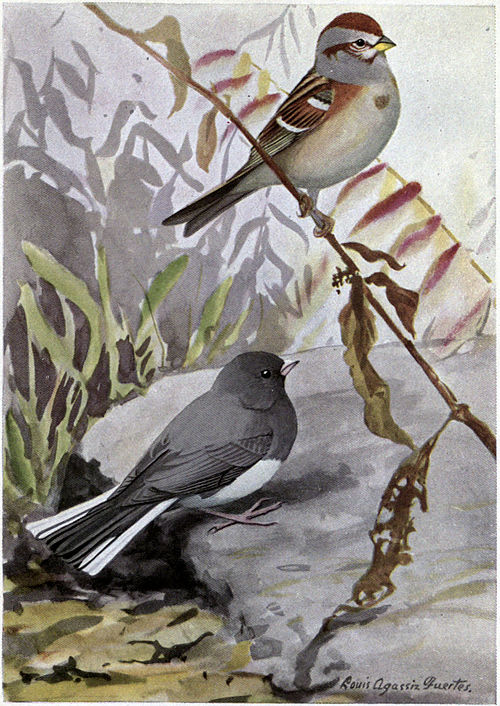
tree sparrow

Like the dark-eyed junco and white-throated sparrow the american tree sparrow appears in New England with the first frost and replaces a similar looking summer resident, the chipping sparrow. The tree sparrow is a tight packed bird, with handsome slate gray and cinnamon stripes on the face. With a dull grey chest marked by a single dark spot this sparrow can often be identified by using the time of year. Consider this data from ebird.org comparing the reported observation of tree sparrows and chipping sparrows in Massachusetts over the course of a single year.
Besides a three week period in April and November notice how the arrival and departure of the chipping sparrow (green line) is in direct correlation with the departure and arrival of the tree sparrow (orange line). This type of seasonal movement is an important clue in identifying a bird and is often only learned through personal observation or anecdote.


Louis Agassiz Fuertes
The (poorly named) tree sparrow is most often found in open fields and low brush. They will visit feeders, though often pick seeds from the ground  and seem to dart around nervously, like an Englishman trying to order pastrami at a New York deli. Listen for the choral of rainy, crystalline “chwee” notes given by groups of these New England sparrows.

November 21, 2013

Winter Migrants – the unseen migration

Boreal Songbird Initiative
With an earlier dusk and longer nights winter lends itself to sky gazing, even if from the car on the commute home. The moon and Orion seems to be always visible though come spring we may forget to look for Cygnus the swan. In the reverse late fall brings a dying of the light, withering plants, and departure of the summer songbirds. Most school children can tell you that “birds fly south in the winter” but there is more to the story. New England lies roughly between latitudes 44° degrees north (Bangor, ME) to 41° north (Providence, RI) literally slap dap in the middle of the Northern Hemisphere. This unique location makes New England a migratory stop over for both tropical birds heading north to breed in the summer and boreal birds heading south to lay over in the winter. Like the summer constellations these winter migrants often go unnoticed and most certainly unappreciated. 

The birds that make up New England’s winter migrants consist mainly of three groups: “winter ducks” that include ducks, grebes, and loons; “winter finches” including finches, sparrows, buntings, and larks; and “winter raptors” including some eagles, hawks, and owls. 

Winter migrants are also hiding in plain sight and include species that we see year round including such favorites as Black-capped chickadees, Blue jays, and American robins. Yet, these birds may in fact be northern birds wintering in our parks and back yards waiting to be seamlessly replaced by different individuals of the same species come spring. In simpler terms the Robin eating dried crab apples from your crab apple tree in February will fly north to northern Saskatchewan come March only to be replaced by a Robin currently in Virginia who will build it’s nest under your eave come summer. 

Whether bobbing quietly in the bays and ocean waters, picking seeds from frozen farm fields or hiding in plain sight the story of these winter migrants is no less incredible than those of their spring counterparts the warblers, bobolinks, and thrush. The winter migrants make a journey of thousands of miles from the boreal forests of northern Canada.

This deepening understanding of both spring and winter migrants is a reminder that “our” New England birds are in fact multi-national travelers involved in complex and ancient migrations. Their story confirms that conservation efforts must be made globally, that our understanding of even “common” birds is limited by our sedentary ways, and that watching a Chickadee take  a sunflower seed from your feeder is in fact bearing witness to a tiny snapshot in a worldly swept life.

October 31, 2013

Dark-eyed junco

These small, arctic-breeding sparrows have arrived in New England for the winter. Juncos are like a slate grey Easter egg half dipped in white and sprigged with a longish tail that's grey in the center and framed by white. Watch for these winter charmers picking seeds from under the evergreens and beneath the bird feeder. Juncos forage in loose, mixed flocks with other sparrows. As ground feeders, they scurry from the fields on short, quick flights into the cover of tall weeds or brush, giving a short, trill series of metallic sounding "chips". When the juncos arrive, winter is near.

October 11, 2013

Sponsorship for Nancy Claflin

From 2008 – 2011 I volunteered with the Massachusetts Breeding Bird Atlas II. This four year project surveyed Massachusetts for evidence of breeding bird species on 1055 individual blocks of land. The entire state was “atlassed” and the outcome has created several very important documents including the Breeding Bird Atlas 2 eBook and the State of the Birds 2013. 

Mass Audubon is currently raising funds to support the creation of a public Breeding Bird Atlas 2 website. As part of this effort I am working to raise $200 to dedicate a page to my bird watching mentor Nancy Claflin. Being bird watchers Mass Audubon has allowed participants to select a specie to dedicate. I  selected the American kestrel for Nancy.  If you would like to support this wonderful effort with a small donation it would mean not only seeing this important environmental resource made public but also memorializing a very special lover of birds in the process. 

To support this project please 
Mail checks made out to: Mass Audubon
With the memo line: BBA2 sponsorship for Nancy Claflin

To:
Karen ONeill
Massachusetts Audubon Society
208 South Great Road,
Lincoln, MA 01773

I'd also love to hear from anyone who remembers Nancy, makes a donation in her memory, or has other questions. AlexanderJosephDunn@gmail.com 


My History with Nancy
At a very precarious voice cracking, adolescence moment I was blessed to have been connected to Nancy Claflin by my fifth grade teacher Jen Tobin who knew we both shared a love of birds. Nancy was fifty years my senior and a gentle yet wind hardened Yankee. She was also an avid fisherman and bird watcher. Despite our obvious differences Nancy began to teach me the ways of bird watching. She would pick me up at 6:30 AM and walk me quietly through the woods of Lincoln or around the rock shores of Cape Ann. She pointed out Northern flickers and Harlequin ducks, we counted Red-tailed hawks on Rt. 128 as we drove north to Plum Island and in the spring she showed me how to connect the tiny foot paths of Mt. Auburn Cemetery. Nancy’s fearless commitment to see birds included breaking suddenly on a highway off ramp, a daring and highly illegal move. She’d hop out of her Jeep and scan the grassy terrain from among the hubcaps of the breakdown lane. She would utter a slow, calm inviting “Ohh..?” and I’d instantly know she had seen something good. 

Highway cloverleaves create islands of nature in a sea of concrete and racing cars, and more often than not a tiny Kestrel would be frozen in mid air making “forays into the open, heading into the wind with the body tilted diagonally upward and hovering with the tail fanned out" (BBA 1). Inevitably the state police would pull up behind us and she’d quietly hand me the car keys. “Tell them your grandmother was about to be sick.” We’d tuck our binoculars into our jackets, apologize to the trooper’s unflinching face, and with my paper learners permit carefully folded into my nylon wallet we’d continue on towards Plum Island or some other far off adventure. This is how bird watching got under my skin and despite a childhood fear that one day I would give it up the hunger is, thanks to Nancy, still very much alive.

Why the Kestrel?
I recently came across Nancy’s entry on the American kestrel in the Massachusetts Breeding Bird Atlas 1, completed in 1979. The original Atlas was published and volunteers wrote “species accounts” for each included bird. Nancy wrote the essay on the American kestrel. Finding Nancy’s entry on this little falcon the “most colorful of North American hawks” was like finding an unopened letter in a locked drawer, her voice buried under the leaf litter leaped into flight. Nancy’ parting words on the state of the kestrel in Massachusetts is a hesitant, final whisper to an essay written with great joy. Sitting just below the graphics like an italicized, almost clairvoyant after thought is her note: “fairly common and widespread in grasslands and similar open situations; possibly declining.”

Part of the work being done by Mass Audubon is comparing the first Atlas with the more recent atlas that I worked on. Significant trends both positive and negative can be seen. One species in particular has come forward as a signal of habitat loss, the American kestrel. The kestrel, the same kestrel that Nancy wrote about for the first Atlas relies heavily on farm fields and open pastures. This type of habitat has been decimated by the decline of local agriculture and the invasive spread of suburban sprawl. Nancy was correct in predicting this “possible decline” and the small, misnamed sparrow hawk stands now as symbol of a changing Massachusetts landscape and quiet loss happening beneath our very nose.

I have great faith that through the continued work of organizations like Mass Audubon, citizen scientists, and bird watchers around the state we will be able to stem the tied of habitat and species loss.


Schedule Alex for a field trip, lecture or classroom visit

Enter your email address to receive notifcations when new posts are published:

Delivered by FeedBurner