Showing posts with label oct. Show all posts

October 11, 2014

The ubiquitous Blue jay, stealer of chips, chaser of cats, lone Canadian major league baseball team


Most bird watchers learn to identify the Blue jay as a child, the stuff of early readers “blue is for Blue jay” and the smiling, more recently frowning mascot for the Toronto baseball team, Blue jays are one of those birds “that everyone knows.” However, jays are more complicated than we may give them credit for. Members of the corvid or crow family, jays are intelligent socialites that stash acorns stores for winter and even migrate. If a jay seems to be extra jowly, gobbled with thick neck, they may be transporting “mast” the harvest of seeds and nuts produced in the forest. Acorns are a favorite and jays will carefully stash these precious swallows of fat and oils in trees, shallow holes, or under rocks to fortify them during the winter.  Beginning around the Jewish New Year Blue jays can be seen passing over roads in low flights above the tree tops. The jay’s flight style is an open winged glide, on surprisingly long “fingers” or primary flight feathers. An overall roundish wing, with blockish head, they often appear white and grey, the illusive blue of their back and head, washed out by the sky’s light. 

October 31, 2013

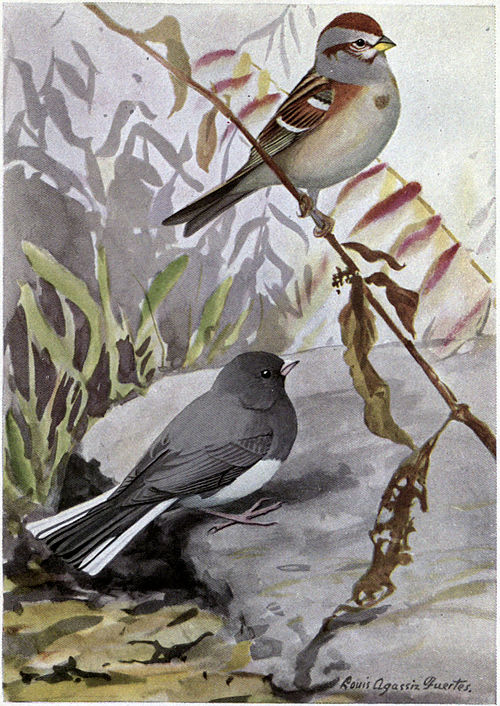
Dark-eyed junco

These small, arctic-breeding sparrows have arrived in New England for the winter. Juncos are like a slate grey Easter egg half dipped in white and sprigged with a longish tail that's grey in the center and framed by white. Watch for these winter charmers picking seeds from under the evergreens and beneath the bird feeder. Juncos forage in loose, mixed flocks with other sparrows. As ground feeders, they scurry from the fields on short, quick flights into the cover of tall weeds or brush, giving a short, trill series of metallic sounding "chips". When the juncos arrive, winter is near.

October 9, 2013

White-throated sparrow – boreal ambassador


Julieta Leon
The male White-throated sparrow has a surprisingly striped head, with lines of white and brown running from its beak to the back of its neck, tinged with yellow in the front. The bird gets its name from a small flash of white feathers just under its beak. This sparrow is best known as a winter arrival to New England, moving in loose flocks from underneath bird feeders to forest edge. These ground feeding birds can be found in meadow shrubs or turning over leaves on the forest floor. The White-throat is also known for its haunting song, a melancholy series of clearly articulated notes, slow and proud, with a hint of waiver. New England folklore translates this song as, “Poor Sam Peabody, Peabody, Peabody” while Canadian bird watchers hear, “Oh sweet, Canada, Canada, Canada.” The Canadians may have bragging rights to this bird as an estimated 83% of the North American population nests in the boreal region of Canada.

 In New England the White throat’s population is on the decline. According to the 2011 publication, State of the Birds data from breeding bird atlas shows less breeding incidents than in 1974 (the last atlas). A smaller west coast population are showing an increase. This east coast / west coast dichotomy in part reflects the fact that the once agrarian east coast is now largely forest, growing older every year. Funny to think that the birds decline may reflect an end to the man made process of land clearing for agriculture.

October 30, 2012

Red-breasted Nuthatch - a winter irruption


The diminutive, eye-striped, lesser known cousin of the familiar White-breasted nuthatch is making a big showing this fall throughout New England. Typically found in sandy, pine forests of Cape Cod and higher elevations the Red-breasted nuthatch (known to birders as the “R.B. Nut”) is expected to have a “winter irruption” this year. Irruptions, unlike migrations are not annually occurring movements but rather population shifts caused by environmental factors such as food availability. This is to say when there is a bad pine cone harvest R.B. Nuts move south into areas where food is available. Each winter Southern New England may have an increase or decrease in a number of species from common birds such as Blue Jays to more uncommon visitors such as Red Crossbills and Evening Grosbeaks. One of this year’s irruptive species is the Red-breasted nuthatch. Watch for these birds among stands of pine trees or feeding from the suet feeder. Listen for there comical “toy, tin horn” call, a nasally “meep-meep-meep.” For more on irruptive winter species visit Ron Pittaway's Winter Finch Forecast.


October 29, 2012

The Couch Birder - what to watch

Late fall can bring that particular kind of spirit dampening darkness, spritzed with 40 degree rain, coupled with a "I finished the whole bag of peanut-butter cups that I bought for the trick-or-treaters" hangover. On such a day sometimes the couch and some television is the only cure. New Hampshire public television recently released their documentary, "Saving Songbirds" and from the clips I've seen so far it looks excellent. 

"Saving Songbirds" focuses on the major conservation efforts happening to protect passerines, and more importantly frames this work globally. This global perspective is an important one not only for conservationists but for all of us. It highlights the fact that the tiny, colorful, musical birds that fill New England in the spring are only visitors to our stone fenced world or as Stevie Wonder might call it, "part time lovers." The warblers, flycatchers, thrush, and vireos are transnational travelers of the first degree. Whether Yankee expats living in Jamaica or a Jamaican emigrants to New Hampshire, you can decide but the important take away is that the biosphere in which these birds live is a changing, amorphous layer of life that covers our earth like a thin smear of glory. Our actions have reactions, our movements have counter movements and what we see out our window is but a single still frame from a long movie reel - only part of the story. 

New Hampshire residents check your local listings, for those who "don't live free or die" watch clips online at NHPTV.org or purchase a copy on DVD. Happy couch birding. 


Watch Saving Songbirds | Preview Trailer on PBS. See more from WENH.

October 25, 2012

Online Resources for Better Bird Watching - Ebird


The Natural History of Selborne - journals of Gilbert White
Beginning in the late 19th century the field of “natural philosophy” took a hard turn away from the casual naturalist wandering the hills and dales and moved indoors to the labs and collection halls of the University. This move away from the observations of farmers and fishermen, hunters and bird watchers towards “hard science” meant individuals from outside the academic circle had little input on the research and publications of the day.

Since the 1960s academia, has arguably loosened its monopoly on the field of natural history, acknowledging the role of “amateur” observations. What is most commonly referred to as, “citizen science” is a push toward inclusion. The power of citizen science is the breadth of data that can be easily collected from thousands, even millions of locations. The advent of the Web and its ability to easily communicate and instantaneously share data online citizen science projects have literally connected millions of nature journals into a single source of searchable data. 

One of the more impressive outcomes of this online citizen science data is “Ebird,” a website dedicated to recording and sharing bird watching observations from across the United States. Ebird (www.Ebird.org) is a collaboration between the Cornell Lab of Ornithology and the National Audubon Society. The concept is simple, allow folks to enter their own list of species and tie that list to a specific location and time. 

Since 2002 Ebird has collected over 3 million observations from bird watchers across the U.S. and has begun to process this raw data into usable, graphical information and there are many features to explore and utilize within the website that make for powerful teaching tools for the classroom teacher, informal educator, or curious naturalist. Below are a few highlights. 

Store, tabulate and compare you own data by using the “submit observations” feature. Follow the simple steps of free registration, enter the location of your observation (local park, school yard, conservation area etc), enter the time and date, and then click the species you observed into the online checklist. Ebird saves and adds your observations into their databases but you can go back month to month or year to year to compare your sightings and track individual species. 

Find locations to look for birds by clicking on Explore Data then Range Maps. Locate both trip lists or the frequency of a single species based on location. This is a great way to identify good areas for a field trip or weekend bird watching adventure. 

Compare the monthly frequency of up to five species at once through the Explore Data then Line Graphs feature. This feature allows you to see the seasonal changes in various species. 

What can only be described as amazing, watch the animated Occurrence Maps. Using a black and white map of the United States specie occurrence data is overlaid using a concentration of color, ranging from dusty orange indicating low frequency to bright white indicating high frequency. A sliding bar at the bottom of the map loops from January to December, giving the viewer an animation of seasonal observations from across the country. What transpires is nothing less than incredible. A glowing algae bloom of bird movement, created solely by individual observations. We can literally watch as Chestnut-sided warblers burst from the gulf of Mexico in April and flood northward in a matter of weeks, leaving the lower 48 by May, but for a few strips of breeding birds in the Appalachian mountains. Watch Longspurs descend from Canada in the winter or the mysterious migration of the Blackpoll Warbler. 


October 24, 2012

Long-tailed ducks


More wonderful video provided by the Cornell Lab of Ornithology

October 26, 2011

Palm Warbler – low down, tail bobber


The Palm warbler is an early arrival and late departure from the New England woods and wetlands edge. This small warbler is one of the more considerate warblers to the bird watcher. Slow moving, ground to eye level feeder that maintains yellowish plumage all year long. Often found in small flocks of two to six the Palm warbler was poorly named by some southern naturalist who happened upon this hardy warbler in a palm tree. This warbler is far more at home along New England’s rives and ponds, moist fields, and woodland edge. With a drab back and yellow head, the Palm warbler has a tell-tale red cap (not always visible), and yellow under tail coverts. This bird is also a notorious tail-bobber, continuously raising and snapping its tail, not to a rhythm but like the head of an old man listening to his friend talk politics. “I agree, yup, yeah I agree, yup, yup, you said it.” Though the spring song, a soft trill, is mostly gone the Palm warbler will still utter a concerned, “chip” call during fall migration. Palm warblers don’t travel as far south as some warblers so can be seen earlier and later in the season than many other species, as such they serve as a wonderful first sign of spring as well as late fall reminder that there is life at summer.

Schedule Alex for a field trip, lecture or classroom visit

Enter your email address to receive notifcations when new posts are published:

Delivered by FeedBurner